COP quickstart
Two ways to compute COP in CEDAR: Climate & Energy Diagnostics for Applied Refrigeration:
a fast, vectorized class for ambient temperature fields, and
a minimal “single state” helper for one operating point.
Tip
For a longer, figure-heavy tutorial adapted from cedar.ipynb, see
Cedar walkthrough.
1) Vectorized workflow — SingleFluidCOP
from cedar.metrics.cop import SingleFluidCOP

hp = SingleFluidCOP(
    "R134a",
    t_evap_k=273.15,
    delta_t_cond=10,
    eta_is=0.8,
    delta_t_min=10.0,
)

print(hp.cop(298.15))                # single value (K)
print(hp.cop([280, 290, 300]))       # vectorized over an array
hp.plot(show=True)                   # quick reference plot
# Or save instead of showing:
# hp.plot(show=False, save_path="outputs/r134a_cop.png", dpi=300)
Note
SingleFluidCOP builds a dense lookup table once (CoolProp sweep) and then
returns fast interpolated values for arbitrary 1–3D arrays of ambient
temperature.
2) Single state helper — cop_single
from cedar.physics.cop import cop_single

cop = cop_single("R134a", t_evap_k=273.15, t_cond_k=295.0, eta_is=0.8)
print(cop)  # returns NaN if the state is unphysical
Warning
cop_single is intentionally minimal: no input validation, plotting, or
logging. Use it inside higher-level code that handles those concerns.
Notes & tips
Refrigerant names are validated against CoolProp (in the vectorized class).
Unphysical conditions (e.g.,
t_cond_k <= t_evap_kor too small lift) returnNaN.Temperatures are Kelvin. If you think in °C, use
T[K] = T[°C] + 273.15.
SHR quickstart
Compute Sensible Heat Ratio (SHR) using temperature plus either relative humidity or dew point.
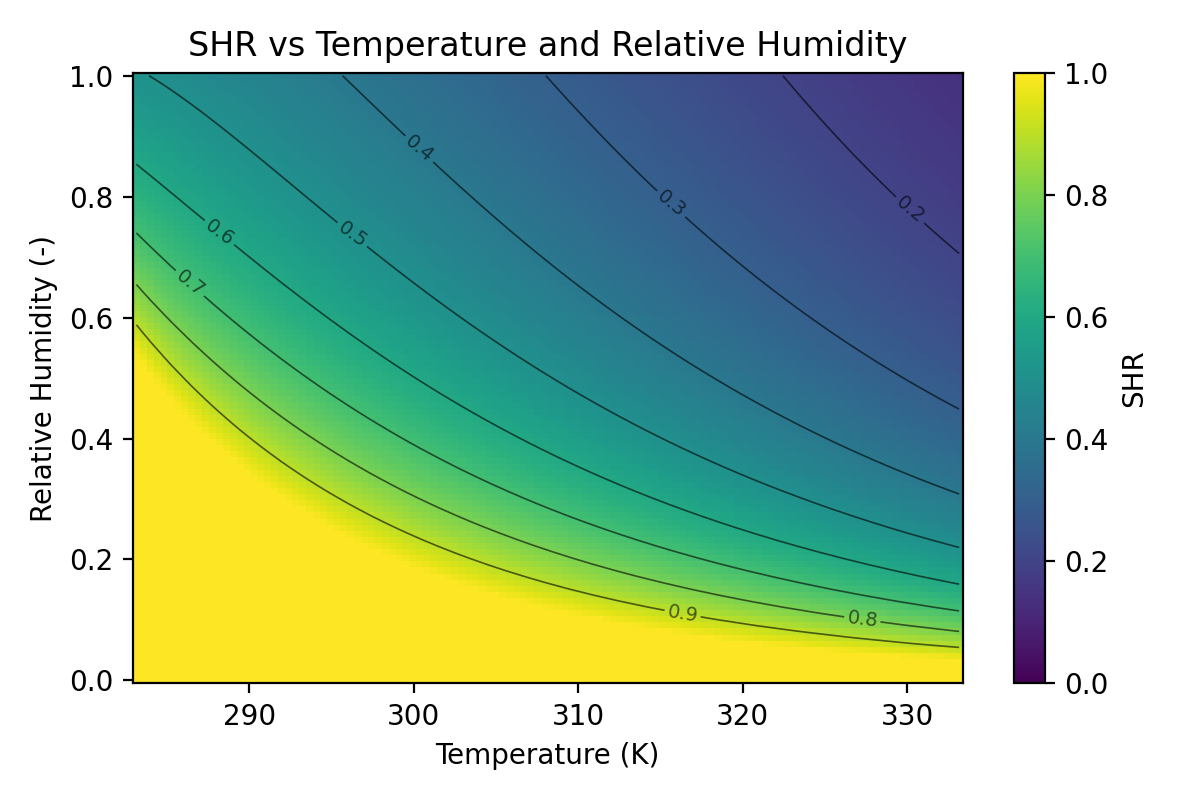
Example SHR map for temperature (x) and relative humidity (y) with 0.1 contours.
from cedar.metrics.shr import SensibleHeatRatioModel

shr_model = SensibleHeatRatioModel(
    p_atm=101_325.0,
    t_evap_k=273.15,
    approach_temp=1.0,
    C_p=1020.05,
    H_fg=2.501e6,
    rh_out=1.0,
)

# Dew point path (dew point -> RH -> SHR)
temps_K = [295.0, 300.0]
dewpoint_K = [283.15, 288.15]
shr = shr_model.shr(temps_K, dewpoint_array=dewpoint_K)
print(shr)  # e.g., [0.704..., 0.62...]

# Or provide relative humidity directly
rh = [0.47, 0.65]
shr_direct = shr_model.shr(temps_K, rh_array=rh)
If you pass both rh_array and dewpoint_array, or neither, the model raises a
ValueError to prevent ambiguous inputs.
See also the runnable scripts in examples/:
examples/cop_example.pyfor COP basicsexamples/shr_example.pyfor SHR via RH or dew pointexamples/effective_cop_example.pyfor ECOP (COP × SHR) using COP/SHR kwargs
ECOP quickstart (COP × SHR)
Compute effective COP by combining COP and SHR models.
from cedar.metrics.effective_cop import EffectiveCOP

ecop_model = EffectiveCOP(
    cop_kwargs=dict(
        fluid="R134a",
        t_evap_k=273.15,
        delta_t_cond=10,
        eta_is=0.8,
        delta_t_min=10.0,
    ),
    shr_kwargs=dict(
        p_atm=101_325.0,
        t_evap_k=273.15,
        approach_temp=1.0,
        C_p=1020.05,
        H_fg=2.501e6,
        rh_out=1.0,
    ),
)

temps_K = [295.0, 300.0]
dewpoint_K = [283.15, 288.15]
ecop_vals = ecop_model.ecop(temps_K, dewpoint_array=dewpoint_K)
print(ecop_vals)  # COP × SHR
Note
Keep COP and SHR assumptions aligned (e.g., same evaporator temperature, approach temperature, outlet RH) so ECOP and eCDD reflect one operating point.
CDD & eCDD quickstart
CDD (hourly exceedance):
from cedar.metrics.cdd import CoolingDegreeDays

cdd = CoolingDegreeDays(base_temperature_K=18.0 + 273.15)
temps_K = [290.0, 293.0, 296.0]
exceed = cdd.cdd(temps_K)
print(exceed)
eCDD (CDD / eCOP):
from cedar.metrics.effective_cdd import EffectiveCDD

ecdd_model = EffectiveCDD(
    cop_kwargs=dict(
        fluid="R134a",
        t_evap_k=273.15,
        delta_t_cond=10,
        eta_is=0.8,
        delta_t_min=10.0,
    ),
    shr_kwargs=dict(
        p_atm=101_325.0,
        t_evap_k=273.15,
        approach_temp=1.0,
        C_p=1020.05,
        H_fg=2.501e6,
        rh_out=1.0,
    ),
    cdd_kwargs=dict(base_temperature_K=18.0 + 273.15),
)

temps_K = [295.0, 300.0]
dewpoint_K = [283.15, 288.15]
ecdd_vals = ecdd_model.ecdd(temps_K, dewpoint_array=dewpoint_K)
print(ecdd_vals)